The Walk from Mürren to Lauterbrunnen
Journal
The Walk from Mürren to Lauterbrunnen
Notes on walking down from Mürren to Lauterbrunnen and photographing the Bernese Oberland in black and white.
Print details
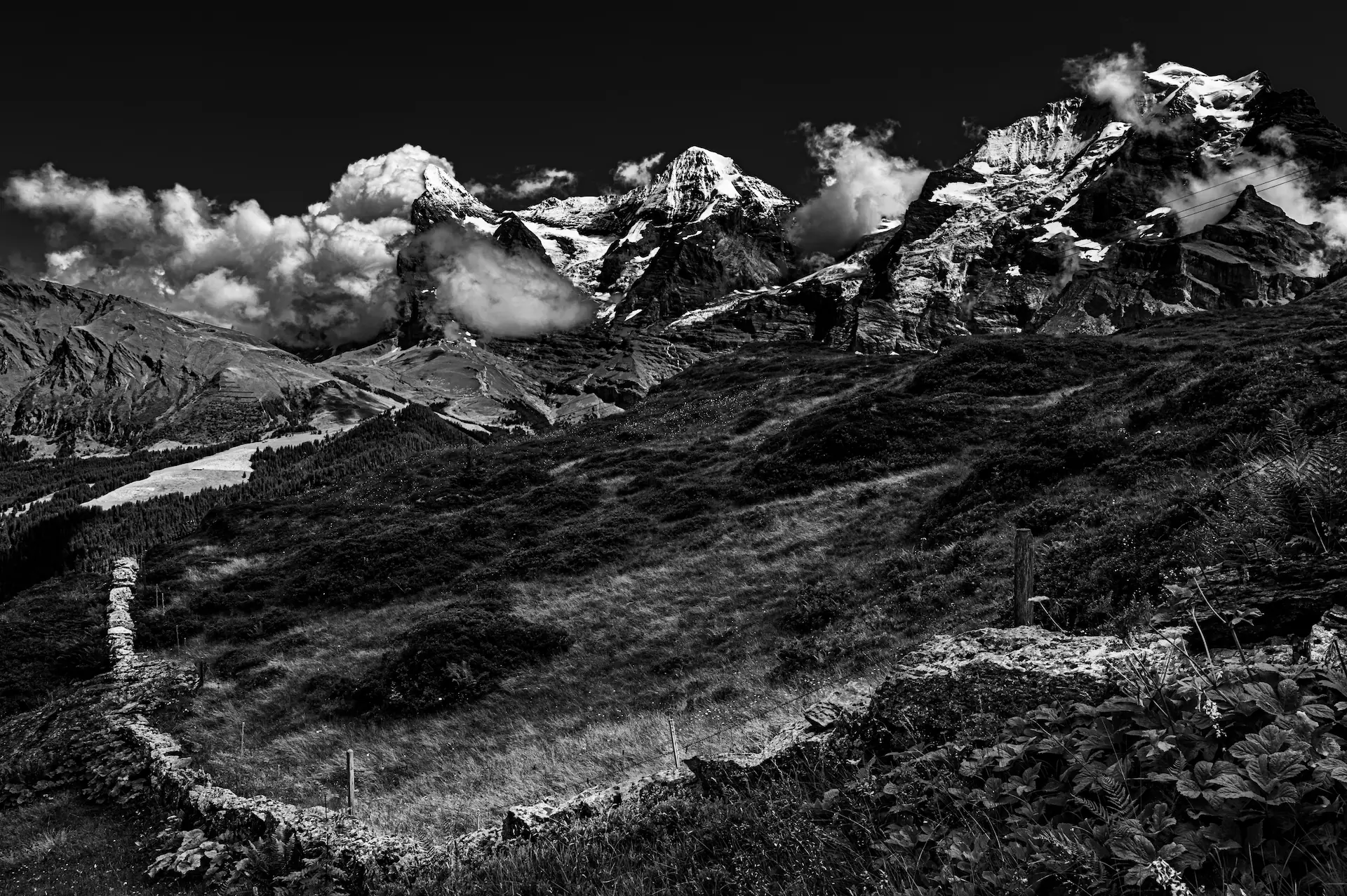
Buy this printI still think about the walk from Mürren down to Lauterbrunnen. From a distance the Bernese Oberland is all huge mountains, but on the path it gets much smaller and closer: wet grass at the edge of the trail, old timber, clouds shifting, and now and then a stone wall that leads your eye straight across the view.
I had seen big mountain views before, but this descent was different. Mürren sits high above the valley, and as you walk down from it the scale keeps changing. One minute you’re looking at the peaks, the next at a bend in the path, a fence post, a patch of shadow, or a single house under an enormous sky. That switching between big and small matters to me as a photographer. It’s often what separates a record of a place from a photograph with a point of view.
The slower pace of seeing
Walking slows down my looking. If you arrive somewhere quickly, it’s easy to take a few impressions and move on. On foot you see things in order: the valley opening up, the cliffs getting bigger or smaller, the clouds moving across the Eiger, Mönch, and Jungfrau. The view stops being one big picture and becomes a lot of smaller ones, each about how something near sits against something far away.
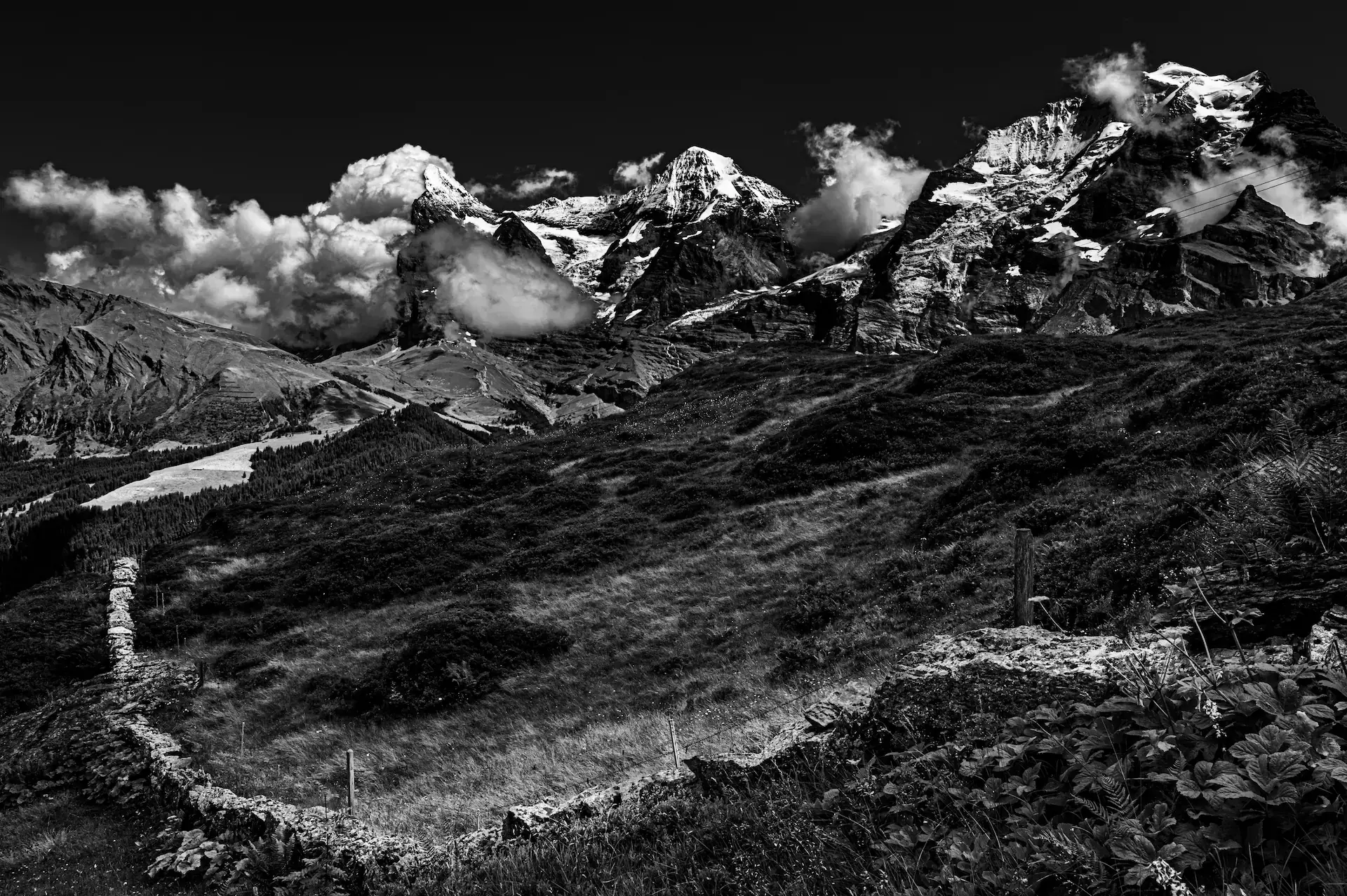
That’s what drew me to the scene that became Alpine Giants: Wengen Panorama. The three famous peaks are in the distance, but the dry stone wall in the foreground is what holds the picture together. It gives you a sense of scale, and it’s a reminder that people built and farmed this landscape long before I turned up with a camera.
Why black and white felt right
People often ask why I shoot some places in black and white. In the Bernese Oberland it let me simplify the picture without losing anything important. The mountains are already overwhelming, and colour can make a photograph too literal, as if it’s just describing the scene. In black and white I could concentrate on shape, contrast, and the way the wall leads the eye to the peaks.
The weather helped. The light wasn’t dramatic, but it kept changing. Clouds moved in layers, patches of sun drifted across the slopes, and the darker foreground gave the frame some weight. The picture would have worked in colour too. In black and white the rough stones in front and the sharp mountains behind play off each other more clearly.
That goes for my whole landscape collection. I’m not just after dramatic places. I’m looking for pictures where the weather and the shape of the land work together, so the photograph is calm without being empty.
The descent into Lauterbrunnen
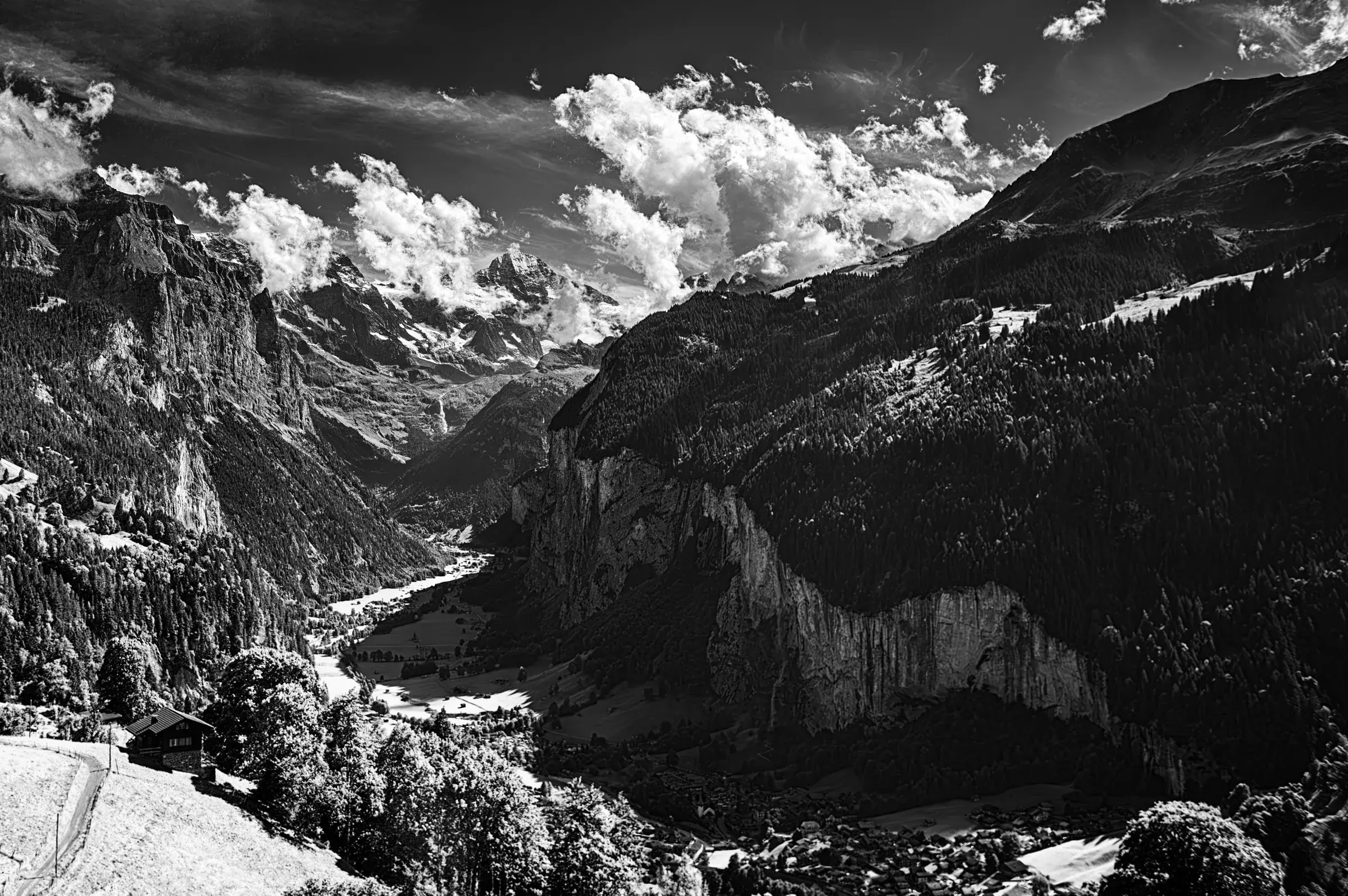
Further down toward Lauterbrunnen the mood changed again. The valley got deeper and the walls closed in. You could hear water everywhere, even where you couldn’t see it. The slopes are so steep that every clearing only lasts a few steps. It’s easy to see why people remember this route: the landscape reveals itself at walking pace, one section after another, like scenes in a film.
What I took away from the day was more than a memory of famous mountains. The walk made me look more patiently. It reminded me that good photographs rarely come from forcing things. They come from staying in a place long enough to see how it fits together.
I think that’s why some places stay with you. Mürren, Wengen, and Lauterbrunnen are spectacular, but what I remember is the mix of huge views and small details.
What remains afterwards
When I look at the photograph now, I remember more than the view. I remember the air, the pace of the walk down, and how the wall broke up the sweep of the valley just enough to make the mountains look even bigger. I found that picture by walking, not by going looking for it.
That’s what the route from Mürren to Lauterbrunnen taught me: pay attention first and take the picture second. It’s a big part of why I keep going back to the mountains with a camera.
From this journal entry
Keep exploring the work behind the essay
Follow the image, the print route, or another field note to keep the browsing path editorial and crawlable.
Related photograph
Alpine Giants: Wengen Panorama
View the artwork detail page and its collecting context.
Collection
landscape
Browse more photographs from the same body of work.
Prints
Collect this image
See edition details, size options, and print information for this work.
Related journal entry
Night Portico, Ascoli Piceno
A portico in Ascoli Piceno at night: arches going back into shadow and stone columns lit by the streetlights.
Related journal entry
Lessons from Geese: Wisdom in Formation
Robert McNeish's short text on why geese fly in a V, and what it says about sharing the work and looking after each other.